
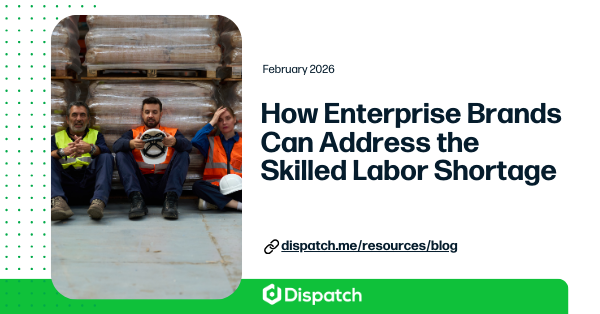
The skilled labor shortage is no longer a temporary disruption. It is a structural workforce shift that is redefining how field service organizations operate.
By 2029, nearly 15 million Americans will have retired since 2024. Replacing that experience will take years. In the meantime, enterprise service brands face a growing gap between labor capacity and service demand.
For manufacturers, warranty providers, property managers, and other distributed service organizations, the skilled labor shortage creates measurable operational pressure. Cycle times extend. First-time fix rates fluctuate. Coverage becomes uneven across regions. Leadership teams spend more time solving staffing gaps than improving service quality.
At the same time, customer expectations continue to rise. Faster response times, clearer communication, and consistent execution are no longer differentiators. They are baseline requirements.
The skilled labor shortage has made one reality clear: traditional operating models built on stable, long-tenured workforces no longer scale.
Before exploring solutions, it is important to understand why this moment represents more than a hiring challenge.
Why the Skilled Labor Shortage Demands Operational Change
Historically, field service organizations relied on centralized teams, predictable labor pipelines, and formal knowledge transfer. Experience accumulated slowly and stayed within the organization.
The skilled labor shortage disrupts that stability. As experienced technicians retire, organizations lose not only headcount but also institutional knowledge. Formal processes that once worked begin to show cracks. Variability increases. Documentation gaps widen. Performance becomes less predictable.
This environment rewards structure, visibility, and coordination.
The skilled labor shortage does not reduce service demand. It increases the importance of managing distributed teams effectively. Organizations that respond strategically strengthen resilience. Those that respond reactively absorb rising operational cost.
The question is no longer whether the skilled labor shortage will affect performance. The question is how organizations will adapt their operating model to address it.
Four Strategic Responses to the Skilled Labor Shortage
1. Expand Capacity With Structured Contractor Networks
Many organizations respond to the skilled labor shortage by increasing their use of independent contractors. When managed well, contractor networks provide geographic flexibility and scalable capacity.
However, contractor expansion without orchestration introduces inconsistency. Job visibility becomes fragmented. Communication breaks down. Performance measurement varies across regions.
The solution lies in integration, not expansion alone.
Leading service brands incorporate contractors into unified systems for job assignment, communication, and performance tracking. Contractors operate within defined workflows and service standards. Visibility remains centralized. Accountability is preserved.
In this model, the skilled labor shortage becomes a coordination challenge rather than a capacity crisis. Workforce flexibility strengthens coverage while protecting the customer experience.
2. Capture Institutional Knowledge Before It Disappears
Every retirement tied to the skilled labor shortage represents decades of field expertise leaving the organization.
When knowledge resides only in individual experience, its departure creates variability and inefficiency. Organizations absorb the impact through callbacks, errors, and longer training cycles.
Forward-looking service brands respond by embedding knowledge directly into structured workflows. Guided procedures, standardized forms, validation rules, and required documentation transform tacit expertise into repeatable systems.
Technicians no longer rely solely on memory or informal mentorship. Instead, they operate within frameworks that reinforce best practices on every job.
In the context of the skilled labor shortage, knowledge capture is a stabilizing force. It shortens ramp time for new technicians and protects service consistency across a changing workforce.
3. Redesign Retirement as a Managed Transition
Demographic shifts are a primary driver of the skilled labor shortage. While retirements cannot be reversed, transitions can be structured.
Some enterprise service brands implement phased retirement programs that retain experienced technicians in mentorship or quality assurance roles. These structured transitions preserve institutional knowledge while accelerating skill development among newer technicians.
By formalizing mentorship, organizations reduce the disruption associated with workforce turnover. Expertise is transferred intentionally rather than lost abruptly.
In this way, the skilled labor shortage becomes an opportunity to design stronger succession planning rather than a source of instability.
4. Embed Upskilling Into Daily Operations
Traditional classroom training alone cannot offset the impact of the skilled labor shortage. Knowledge retention improves when reinforcement occurs within the flow of work.
Modern service organizations embed learning directly into job execution. Conditional forms, structured workflows, and documentation checkpoints guide technicians in real time. Each job reinforces standards and improves execution quality.
This approach shortens onboarding cycles and reduces variability. Instead of relying solely on one-time instruction, technicians develop capability through consistent operational reinforcement.
The skilled labor shortage increases the importance of systems that support continuous improvement rather than episodic training.
The Skilled Labor Shortage Requires a Coordinated Workforce Model
The skilled labor shortage is fundamentally an operating model challenge.
Organizations that navigate it successfully centralize visibility across employees, contractors, and customers. They align people, processes, and platforms to ensure service quality remains consistent across distributed teams.
This coordinated approach is often described as service orchestration. It reflects a shift from fragmented field management to unified service delivery.
Technology enables that shift, but the transformation begins with clarity. Fragmented systems and manual coordination amplify the impact of the skilled labor shortage. Unified platforms create transparency, accountability, and adaptability.
For many enterprise service brands, this evolution includes tools that connect and measure every part of the service experience. The objective is not additional complexity. It is operational clarity.
Turning the Skilled Labor Shortage Into Strategic Advantage
The skilled labor shortage will continue shaping field service for years to come. Demographic trends and rising service demand point in the same direction.
Within that challenge lies opportunity.
Organizations that respond with structured contractor engagement, embedded knowledge capture, managed transitions, and continuous upskilling build resilience. They expand coverage without sacrificing quality. They preserve expertise while modernizing execution.
The skilled labor shortage does not have to define operational decline. It can define operational evolution.
Enterprise service brands that modernize now will not simply navigate the skilled labor shortage. They will redefine what scalable, consistent service looks like in a constrained labor market.