

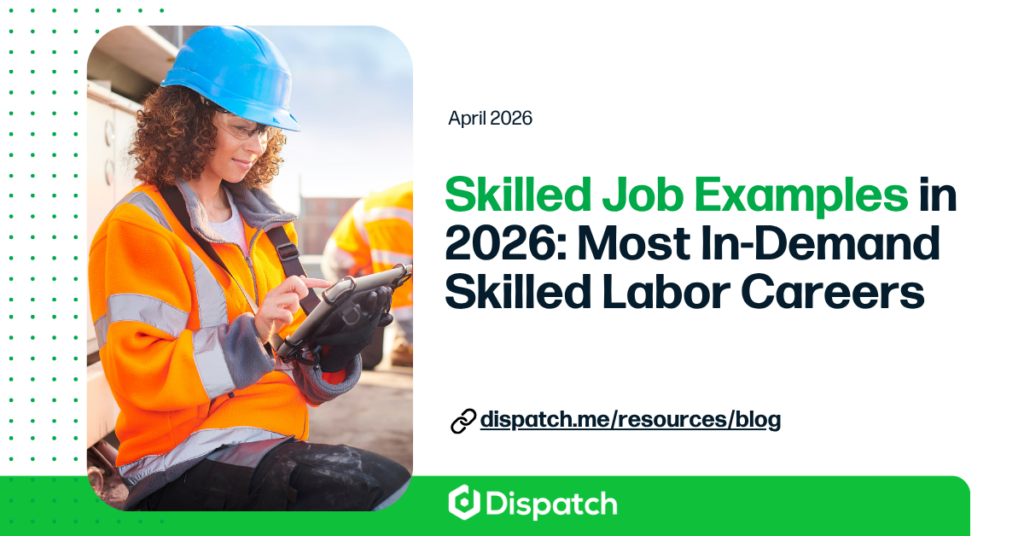
The skilled labor shortage is no longer a future concern. It is already impacting how field service businesses operate every day. Teams are stretched thin, service requests are piling up, and many organizations are struggling to keep up.
At a high level, the most in-demand skilled job examples in 2026 include electricians, HVAC technicians, plumbers, construction workers, and manufacturing technicians. These are not just common roles. They are essential to keeping operations running and customers satisfied. Many of these challenges become clearer when you look at real skilled job examples and how critical they are to daily operations.
When we talk about skilled labor, we are referring to workers who bring specialized training, certifications, or hands-on experience to their roles. Skilled professions require a level of expertise that cannot be easily replaced or automated.
In this guide, we will walk through the most in-demand skilled job examples, the industries feeling the pressure the most, and what leaders can actually do to respond.

What Types of Skilled Labor Are Most in Demand Right Now?
To better understand the gap, it helps to break down specific skilled job examples and where demand is growing the fastest. If you look across industries, a few categories consistently rise to the top when it comes to skilled job examples.
Trade roles are leading the way when you look at the most in-demand skilled job examples. Electricians, plumbers, and HVAC technicians continue to see strong demand across both residential and commercial work. Construction roles are also in high demand as infrastructure and development projects continue to expand. On top of that, manufacturing technicians and equipment specialists are becoming increasingly critical as production environments grow more complex.
To understand why, it helps to look at how the labor market has evolved.
Before 2020, most organizations had relatively stable hiring pipelines. Workforce planning was more predictable, and experienced workers were still active in the field.
After 2020, things changed quickly. A large portion of the skilled workforce began to retire, while demand for services increased across nearly every industry. At the same time, fewer workers entered skilled trades, creating a gap that continues to widen.
Now in 2026, that gap is no longer a short-term disruption. It is a long-term reality.
There are still a few misconceptions that come up in conversations with leaders. One is that trade jobs are declining. In reality, demand has never been higher. Another is that technology will replace skilled labor. What we are actually seeing is the opposite. Technology is increasing the need for skilled workers who can operate, install, and maintain more advanced systems.

What Are Examples of Skilled Field Service Jobs That Need to Be Filled in 2026?
Field service jobs are a specific category of skilled labor that happen on-site. These workers are responsible for installing, maintaining, and repairing equipment or property, often directly in front of the customer.
These skilled job examples are essential because they sit at the intersection of operations and customer experience. When they are understaffed, everything slows down.
Some of the most common skilled job examples in field service today include electricians, HVAC technicians, plumbers, appliance repair technicians, general contractors, facilities maintenance technicians, and equipment installers.
What makes this more complex is how these roles map across industries.
For example, property management companies rely heavily on maintenance technicians and plumbers to keep units operational. Manufacturers depend on skilled technicians to maintain equipment and avoid downtime. Warranty providers need reliable repair professionals to deliver on their service commitments.
The issue is not just demand. It is the ability to actually fulfill the work.
Many businesses are facing situations where service requests are coming in, but there are not enough qualified workers available to take them. This leads to delays, missed revenue opportunities, and inconsistent customer experiences .
For most leaders, this is not theoretical. It is showing up in their metrics and in customer feedback.

What Industries Are Experiencing the Skilled Labor Shortage the Most?
The skilled labor shortage is widespread, and the same skilled job examples are driving gaps across multiple industries.
Manufacturing is one of the most impacted. As experienced workers retire, companies are left trying to maintain output with fewer skilled technicians. At the same time, production demands continue to increase.
Construction is facing a similar challenge. Demand for new builds and infrastructure projects remains high, but the labor force has not kept pace. This creates bottlenecks that can delay entire projects.
Property management and facilities teams are also under pressure. Maintenance needs do not slow down, and service requests continue to come in regardless of staffing levels. Without enough skilled workers, it becomes difficult to maintain service quality across properties.
Trade services, such as electrical work, face an additional challenge. Licensing requirements and training timelines make it harder to quickly bring new workers into the field.
Across all of these industries, the same skilled job examples continue to surface as the hardest roles to fill. They rely on distributed networks of skilled workers to get the job done. When those networks are not strong enough, the entire operation starts to feel the strain.

Can You Survive Losing More Skilled Labor?
For most organizations, the honest answer is no.
Losing skilled labor does not just create small inefficiencies. It directly impacts revenue, customer satisfaction, and long-term growth. Jobs take longer, customers face delays, and internal teams become overextended.
Over time, the impact compounds. As expectations rise, it becomes even harder to deliver consistent service with a shrinking and less experienced workforce.
That is why leaders need to focus on solutions that go beyond hiring.
Capturing institutional knowledge is critical, but it is only the first step. The real opportunity is operationalizing that knowledge by embedding it directly into how skilled labor and field service work gets done.
With guided workflows and built-in compliance checks, organizations can turn best practices into repeatable processes. Less experienced workers are not left guessing. They are guided step by step, with clear guardrails that ensure work is completed correctly and consistently.
This approach does more than standardize execution. It actively supports upskilling by helping workers take on more complex skilled jobs with confidence, while preserving the expertise of experienced laborers.
These strategies do not eliminate the skilled labor shortage, but they make it far more manageable and far less risky.
Common Mistakes to Avoid During the Skilled Labor Shortage
One of the most common mistakes leaders make is assuming the problem will correct itself over time. At this point, it is clear that the shortage is not going away.
Another mistake is relying entirely on internal hiring. While hiring is important, it is not enough on its own. The available talent pool is simply too limited to meet demand.
Training is another area where organizations fall short. Without a structured approach to onboarding and development, new workers struggle to ramp up effectively.
There is also a tendency to overlook the importance of process standardization. When every technician works differently, it creates inconsistency and slows down operations.
Finally, many businesses underestimate the value of their service network. A weak or underdeveloped network makes it difficult to scale and maintain coverage across regions.
Avoiding these mistakes can make a significant difference in how well an organization navigates the shortage.
How Dispatch Helps You Adapt to Skilled Labor Shortages
The skilled labor shortage creates real challenges, but it also forces organizations to rethink how they operate.
Dispatch is designed to help businesses adapt in a more scalable way.
Instead of relying solely on internal teams, companies can use Dispatch to build and grow a reliable network of independent service providers. This makes it easier to expand coverage and keep up with demand.
The platform also simplifies onboarding and engagement, which reduces the time and effort required to bring new providers into your network .
On the training side, businesses can standardize how work gets done by using guided procedures. This helps new workers ramp up faster and ensures more consistent outcomes across jobs.
The end result is a more flexible, resilient operation. Teams can complete jobs faster, reduce operational strain, and deliver a better overall customer experience.
Learn more about how Dispatch Direct can help.
Have a question for us? Schedule time now.
FAQs
What are the most in-demand skilled job examples in 2026?
Electricians, HVAC technicians, plumbers, construction workers, and manufacturing technicians are among the most in-demand skilled jobs.
What industries need more skilled labor?
Manufacturing, construction, property management, and field service industries are experiencing the largest shortages.
Why is there a skilled labor shortage?
The shortage is driven by a combination of workforce retirements, fewer new workers entering trades, and increasing demand for services.
How can businesses overcome the skilled labor shortage?
Businesses can focus on upskilling employees, improving training processes, and expanding their contractor networks.
What is a skilled profession?
A skilled profession requires specialized training, experience, or certification to perform technical or trade-based work.